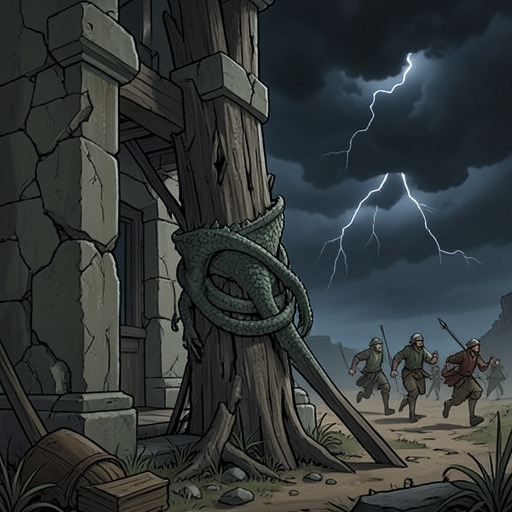
Dragon teeth
Metamorphoses (Ovid Edition)Dragon teeth are not ordinary remains but charged instruments of metamorphosis: when planted in the earth, they produce armed human beings. Their decisive significance lies in the reversal they impose on cultivation. A furrow that should promise harvest instead yields an army, so that the boundary between nature, magic, and warfare collapses in a single field.
Divine Instruction and the First Sowing
The first major use of the Dragon teeth occurs when Pallas descends from the skies to guide a young hero through a dangerous task. She commands him to plow the field and scatter the Dragon teeth across the furrows, while also warning him that embattled armies will rise before his astonished eyes. The teeth therefore operate within a divinely directed procedure: the hero does not discover their power independently, but follows Pallas's instructions in order to bring about a transformation whose consequences have already been foretold.
The act of sowing gives the object an agricultural form while retaining the threat of the slain dragon from which it came. The hero scatters the teeth by hand, and the clods grow warm and crumble where they fall. This detailed physical response marks the passage from inert object to active instrument. The ground itself seems to ferment under their influence, preparing not crops but people equipped for battle.
An Army from the Furrows
The Dragon teeth generate a human crop with startling speed. As the enchanted earth opens, armed forces rise from it, turning the field into a place of emergence and danger. The image is paradoxical: infancy and warfare occupy the same process. The beings come from the soil as though they were seedlings, yet they arrive as an embattled army rather than as peaceful inhabitants. Their birth is thus already organized around collective violence.
Pallas's prophecy and the hero's action form a tightly connected sequence of command, obedience, sowing, and eruption. The object is powerful, but its effect depends on ritual handling and on the authority of a goddess who understands what the field will produce. In this first episode, the Dragon teeth make the hero both cultivator and military founder, while the earth becomes the medium through which a supernatural population is released.
Repetition in Medea's Magic
The same transformation recurs in the trial involving Medea and Jason. Jason advances through fresh attempts and sows serpent's teeth in fertile furrows while the Colchians watch and the Greeks encourage their champion. Here the Dragon teeth again convert agriculture into military production: the enchanted soil makes a human crop appear, and the spectacle is witnessed as both magical wonder and public contest.
The second sowing confirms that the object has a repeatable, almost procedural power. Its effect is not confined to one legendary field or one hero's exceptional experience. Under Medea's magical assistance, the teeth can be deployed as part of a prescribed ordeal, and their emergence becomes a test that Jason must survive. The cheering of the Greeks contrasts with the staring of the Colchians, placing the supernatural harvest inside a scene of political allegiance and competitive judgment.
The comparison between the two episodes also clarifies the teeth's narrative function. In the earlier scene, Pallas supplies the knowledge that makes the sowing possible; in the later one, Medea's skill makes it possible for Jason to confront the same danger. In both cases, success depends less on brute strength than on understanding how the object works and how its violent product can be handled.
Symbolic and Narrative Significance
The Dragon teeth embody a mythic fusion of death, generation, and social formation. They preserve the violence of the dragon even after the creature itself is gone, carrying a dead monster's power into the future. Once planted, that power does not merely destroy: it creates human bodies, communities, and armies. Creation therefore appears as a continuation of conflict by other means, and the origin of a people is imagined through the language of armed emergence.
Their movement from dragon remains to cultivated seed, and from seed to soldiers, gives the object a compressed cycle of transformation. A tooth belongs to an animal body; in the earth it becomes a seed; from the seed comes a human multitude. Yet the final form does not erase the earlier ones. The dragon remains present in the teeth's origin, the soil remains present in their incubation, and warfare remains present in the people they produce.
The recurring image also establishes a sharp contrast between expected harvest and achieved result. Farming ordinarily turns labor into nourishment and continuity. The Dragon teeth instead yield danger, requiring a hero to treat the field as a battlefield even before the army rises. Their power consequently exposes the instability of apparently benign forms: planting can be an act of war, fertility can be militarized, and the birth of a population can carry the memory of violence within it.